World Sailing Championships, SSL Gold Cup 2026, Part 3
The Finnish team’s road to Rio: the qualifying regattas, 14–17 July 2026

Text: Tom Sundman
The Football World Cup has reached the semi-final stage, with just four teams remaining. The Wimbledon tennis tournament concluded at the weekend, and now it’s time to turn our attention to Lake Neuchâtel in Switzerland,
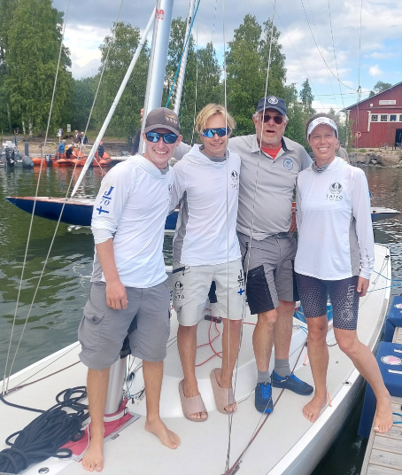
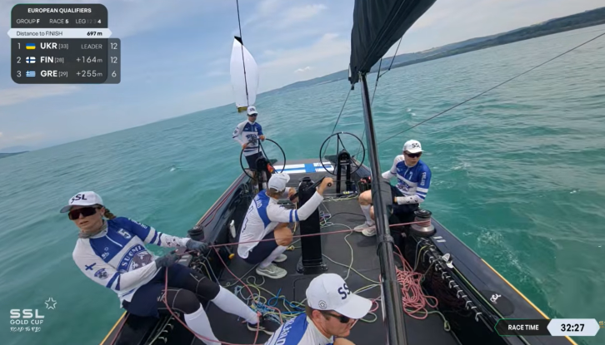
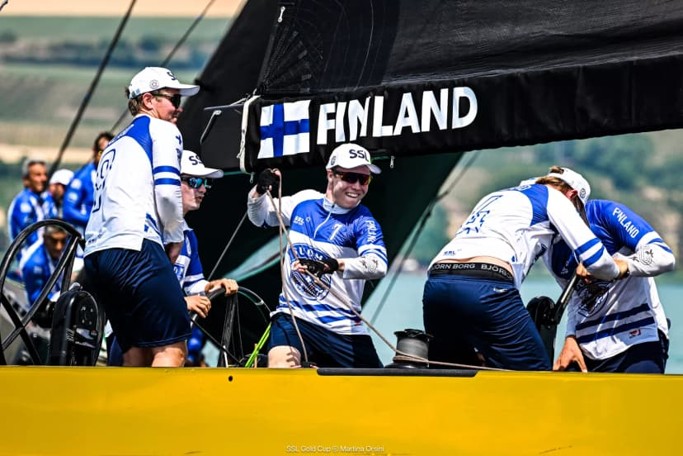
Finland’s road to Rio begins with qualifying races on Tuesday 14 July and will be decided across six races. The photos below are from the team’s training sessions ahead of the competition. Greece and Ukraine are also competing in the same qualifying group, Group F. The winner will travel to Rio. Meanwhile, Qualifying Group G features teams from Portugal, Turkey and Bulgaria. The races can be followed live at https://www.facebook.com/SSLGoldCup
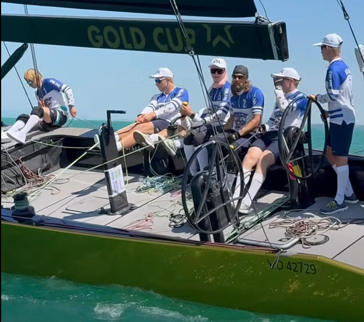
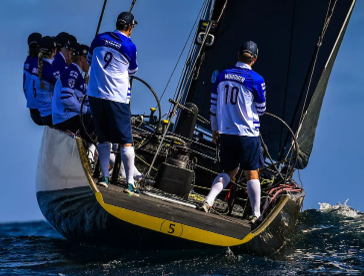
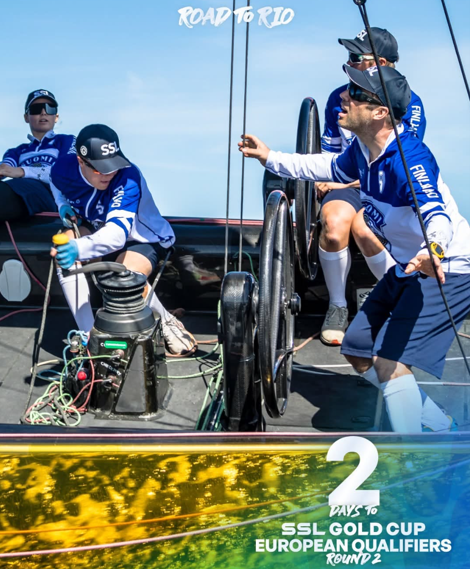
The teams have had a set period of training prior to the competitions. The SSL47 boats are of a one-design type and have been described in a previous article. The teams have been provided with a detailed description of what modifications are permitted and what equipment is allowed. One interesting detail is that the ‘No Electronics’ principle has been abandoned in favour of approving a comprehensive system, common to all boats. The Vakaros system has been introduced at major events over the past few years, including last year’s Star World Championship and, most recently, the European Dragon Championship, which took place on 4 July in Helsinki.
The main principle is that all boats are fitted with a GPS-equipped display, which is also in contact with the judges. The starting line and the turning marks are also fitted with transmitters, and their position can be controlled from the judges’ boat. At the start, the crew can see on the display their position relative to the starting line and the time it will take to cross the starting line at their current speed. If the boat crosses the line too early, a red light flashes. The judges, for their part, can see which boats have made a false start and do not need to give a separate audible signal in the traditional way. When tacking, the crew can see their current course and speed. Spectators can also follow the race live via the internet.
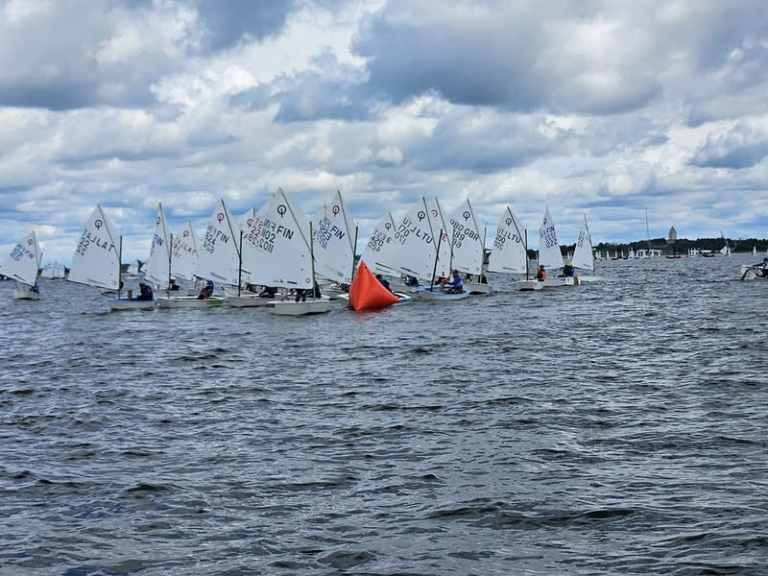
According to some Darkseglare sailors who took part in the European Championships, this was welcome news, as it simplified the start without altering the racing itself. In large starts, the judges have often found it difficult to fairly identify the boats that crossed the line prematurely. This also leads to several restarts and the judges eventually raising a black flag, which means that the boat that false-started must be disqualified. Now, with the P flag, the race can be restarted in the usual way. At the same time, the race can be completed more quickly. As all boats have the same equipment, the electronic system does not give any individual boat an advantage. In this context, ‘time on distance’ – i.e. starting at full speed across the starting line – becomes easier. The SSL Gold Cup is partly sailed as a ‘match racing’ competition, where the tactics are different. It is enough simply to be first across the finish line.
The Finnish SSL Gold Cup team includes Lucas and Simon Karlemo, who were able to practise using the Vakaro system during the recently concluded European Dragon Championships, where they won one race and finished 20th out of 62 competitors. In the results list for the Corinthian division (amateurs only), they came 9th.
Facts about the Vakarios system:
The Vakaros platform is actively used on SSL47 boats during Star Sailors League events. The league utilises the Vakaros RaceSense system to manage starts, track exact locations and provide instant OCS (On Course Side) feedback to the crew without the need for manual line-of-sight calls by race officers. [1, 2, 3, 4]
The Vakaros system on these boats works as follows:
- Hardware Usage: Competitor devices, such as the Vakaros Atlas 2, are fitted to the boats. [1]
- Automated Start Line Judgements: Instead of manually ‘pinging’ the start line or relying on the committee boat’s line of sight, the system constantly tracks precise positional data with an accuracy of 25 cm for both the start lines and each competing boat. [, 2]
- Instant OCS Alerts: RaceSense instantly detects if a boat crosses the start line early, sending immediate feedback to the sailor’s on-board display and virtually eliminating time-consuming general recalls or penalty flags. [1, 2]
Real-time Metrics: When not managing the starting line, the Vakaros Racing instruments provide the crew with live performance metrics, including magnetic heading, speed and heel angle. [1]